


Special Education Needs (SEN) Information Report
The aim of this information report is to explain how we implement our SEND policy. In other words, we want to show you how SEND support works in our school.
If you want to know more about our arrangements for SEND, please read our SEND policy.
Note: If there are any terms we’ve used in this information report that you’re unsure of, you can look them up in the Glossary at the end of the report.
1. What type of SEN does the school provide for?
Our school provides for learners with the following needs:
|
AREA OF NEED |
CONDITION |
|
Communication and interaction |
Autism spectrum disorder (ASD) |
|
Speech and language difficulties |
|
|
Cognition and learning |
Specific learning difficulties, including dyslexia, dyspraxia, dyscalculia |
|
Moderate learning difficulties |
|
|
Severe learning difficulties |
|
|
Social, emotional and mental health
|
Attention deficit hyperactivity disorder (ADHD) |
|
Attention deficit disorder (ADD) |
|
|
Sensory and/or physical |
Hearing impairments |
|
Visual impairment |
|
|
Multi-sensory impairment |
|
|
Physical impairment |
2. Which staff will support my child, and what training have they had?
Our special educational needs co-ordinator, or SENCo
There are 2 full time SENCos at Upton-by-Chester High School.
Miss Jodie Fisher: SENCo (KS3 and transition)
Mr Mark Jones: SENCo (KS4 and 5)
Both SENCos were new to role in September 2024. Miss Fisher is an experienced former Primary School Teacher and SEN teacher in a secondary setting. Miss Fisher delivers Mathematics and English Nurture Intervention to Yr 7 and 8 learners.
Mr Jones is an experienced teacher of Mathematics and former Head of Year at Upton-by-Chester High School. Mr Jones teaches Mathematics to Key Stage 4 learners.
Both SENCos are working towards the NPQSENCO.
Assistant SENCo
Our assistant SENCo is Mrs Julia Jackson
Mrs Jackson has 6 years of experience in this role and has previously worked as a higher-level teaching assistant. Mrs Jackson has worked at Upton-by-Chester High School for over 18 years.
The SENCos and Assistant SENCo have undergone a wide range of training in SEND, Trauma Informed Practice and working with Children in Care.
Teachers
All of our teachers receive in-house SEND training and are supported by the SENCos to meet the needs of learners who have SEND.
Staff have received external training from the following agencies:
- ADHD foundation
- Local Autism team
- Local hearing impairment team
- Local visual impairment team
- Other certified SEND specialists who have delivered on adaptive teaching strategies in the mainstream classroom
Teaching assistants (TAs)
We have a team of approximately 30 TAs, including 3 higher-level teaching assistants (HLTAs) who are trained to deliver SEND provision.
We have 8 teaching assistants who are trained to deliver interventions such as IDL (English, Maths & Wellbeing), Nurture, SALT, ELSA, Executive functioning and Phonics.
External agencies and experts
Sometimes we need extra help to offer our learners the support they need. Whenever necessary we will work with external support services to meet the needs of our learners with SEND and to support their families. These include:
- Speech and language therapists
- Specialist teachers or support services (Hearing impaired and Visually impaired)
- Cheshire West and Chester SEND team
- Educational psychologists
- Occupational therapists, speech and language therapists or physiotherapists
- General practitioners or paediatricians
- School health
- Child and adolescent mental health services (CAMHS)
- Education welfare officers
- Social Services
- Voluntary sector organisation
3. What should I do if I think my child has SEND?

|
If you think your child might have SEND, the first person you should tell are the SENCos in the Support department on
|
Appropriate staff will meet with you to discuss your concerns and try to get a better understanding of what your child’s strengths and difficulties are. Together we will decide what outcomes to seek for your child and agree on next steps. We will make a note of what’s been discussed and add this to your child’s record. |
If we decide that your child needs SEND support, we will formally notify you and your child will be added to the school’s SEND register. They will have a monitoring (M) code if there are emerging concerns and we are tracking progress. They will have SEN support (K) code if there is identified SEND with structured, additional provision in place. |
4. How will the school know if my child needs SEND support?
All our class teachers are aware of SEND and are looking to identify any learners who aren’t making the expected level of progress in their schoolwork or socially. This will be through both classwork and assessments.
If the teacher notices that a learner is falling behind, they try to find out if the learner has any gaps in their learning. If they can find a gap, they will give the learner additional resources to try to fill it. Learners who don’t have SEND usually make progress quickly once the gap in their learning has been filled.
If the learner is still struggling to make the expected progress, the teacher will talk to the SENCo, who will contact you to discuss the possibility that your child has SEND.
The SEND team will observe the learner in the classroom and in social/unstructured time to see what their strengths and difficulties are. They will have discussions with your child’s teachers, to see if there have been any issues with, or changes in, their progress, attainment or behaviour. They will also compare your child's progress and development with their peers and available national data.
The SENCo will ask for your opinion and speak to your child to get their input as well. They may also, where appropriate, ask for the opinion of external experts such as a speech and language therapist, an educational psychologist, or a paediatrician.
Based on all of this information, the SENCo will decide whether your child needs Monitoring (M) or SEN support (K). You will be informed of the outcome.
If your child does need SEND support, their name will be added to the school’s SEND register, and the SENCO will work with you to create a SEND support plan for them.
5. How will the school measure my child’s progress?
We will follow the ‘graduated approach’ to meeting your child’s SEND needs.
The graduated approach is a 4-part cycle of assess, plan, do, review.
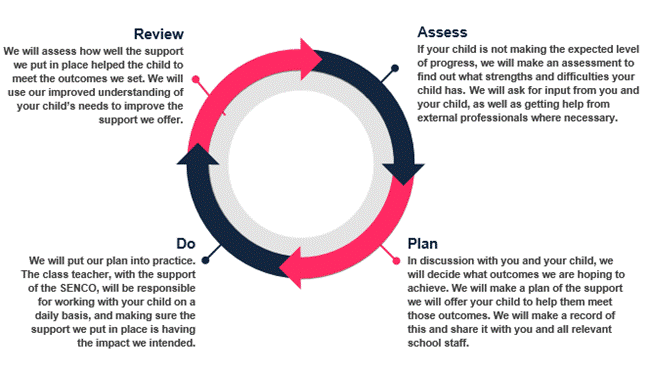
As a part of the planning stage of the graduated approach, we will set outcomes that we want to see your child achieve.
Whenever we run an intervention with your child, we will assess them before the intervention begins. This is known as a ‘baseline assessment’. We do this so we can see how much impact the intervention has on your child’s progress.
We will track your child’s progress towards the outcomes we set over time and improve our offer as we learn what your child responds to best.
This process will be continual. If the review shows a learner has made progress, they may no longer need the additional provision made through SEND support and may be moved to a Monitoring (M) code. For others, the cycle will continue and the school's targets, strategies and provisions will be revisited and refined.
6. How will I be involved in decisions made about my child’s education?
We will provide two formal reports per year that report on your child’s progress, one of which is a full written report. Additionally, learners in Year 7, 10, 12 and 13 will have a 3rd report which communicates their Attitude to Learning (AtL) grades only.
Your child’s teachers will meet you once a year at a Learner Progress Evening to:
- Discuss progress made in individual subject areas
- Set targets in order that your child can make progress
- Discuss the support we will put in place to help your child make that progress and refer any concerns/ queries to the relevant staff e.g the SENCo
- Identify what we will do, what we will ask you to do, and what we will ask your child to do
- The appropriate SENCo will be present at key events, including transition events and Year 9 Options Evening, where they are available to discuss any SEND specific concerns or answer any questions.
Form Tutors of Year 7, 10 and 12 also meet with parents/ carers and learners in their form as they embark on a new Key Stage at Meet the Tutor Evening.
We want to hear from parents and carers as much as possible so that we can build a better picture of how the SEND support we are providing is impacting your child inside and outside of school.
If your child’s needs or aspirations change at any time, please let us know right away so we can keep our provision as relevant as possible.
After any discussion we will make a record of any outcomes, actions and support that have been agreed. This record will be shared with all relevant staff, and you will be given a copy.
If you have concerns that arise between these meetings, please contact your child’s class teacher. SURNAMEINITIAL@uptonhigh.co.uk For example, jonesm@uptonhigh.co.uk
7. How will my child be involved in decisions made about their education?
The level of involvement will depend on your child’s age. We recognise that no two children are the same, so we will decide on a case-by-case basis, with your input.
We may seek your child’s views by asking them to:
- Attend meetings to discuss their progress and outcomes
- Prepare a presentation, written statement, video, drawing, etc.
- Discuss their views with a member of staff who can act as a representative during the meeting
- Complete a survey
8. How will the school adapt its teaching for my child?
Your child’s teachers are responsible and accountable for the progress and development of all the learners in their class.
High-quality teaching is our first step in responding to your child’s needs. We will make sure that your child has access to a broad and balanced curriculum in every year they are at our school.
We will adapt how we teach to suit the way the learner works best. There is no 'one size fits all’ approach to adapting the curriculum, we work on a case-by-case basis to make sure the adaptations we make are meaningful to your child.
These adaptations include:
- Ensuring our curriculum is accessible to all for example, by grouping, adapting the teaching style or content of the lesson, etc.
- Adapting our teaching, for example, giving longer processing times, pre-teaching of key vocabulary, reading instructions aloud, etc.
- Adapting our resources and staffing
- Using recommended aids, such as laptops, coloured overlays, reading rulers, visual timetables, larger font, etc.
- Teaching assistants will support learners in small groups within classes where identified needs have been highlighted
We may also provide the following interventions:
|
AREA OF NEED |
CONDITION |
HOW WE SUPPORT THESE LEARNERS |
|
Communication and interaction |
Autism spectrum disorder (ASD) |
Visual timetables Social stories Consistency and routines Now and Next boards Structured classroom chunking and scaffolding Assistive Technology |
|
Speech and language difficulties |
Speech and language therapy (internal and external) SALT interventions Assistive Technology |
|
|
Cognition and learning |
Specific learning difficulties, including dyslexia, dyspraxia and dyscalculia |
Writing slope Reading rulers Overlays IDL intervention Nurture interventions Assistive Technology |
|
Moderate learning difficulties |
IDL intervention Nurture interventions Assistive Technology |
|
|
Severe learning difficulties |
Nurture intervention Targeted TA support Assistive Technology |
|
|
Social, emotional and mental health
|
ADHD, ADD |
Zones of regulation Time in cards Smaller group work Targeted TA support Learner support plan |
|
Adverse childhood experiences and/or mental health issues |
Nurture groups School Councillor MHST referrals (CAMHS) Staff training on Trauma Informed Practice IDL Wellbeing Kintsugi programme (wellbeing programme) |
|
|
Sensory and/or physical |
Hearing impairment |
Adapted Seating plan Support from HI team Assistive technology Targeted TA support |
|
Visual impairment |
Limiting classroom displays Handouts specific to individual needs e.g larger text sizes / different coloured resources. Overlays. Support from VI team Adapted seating plan Assistive technology RNIB Bookshare Targeted TA support |
|
|
Multi-sensory impairment |
Assistive technology Targeted TA support Adapted resources |
|
|
Physical impairment |
Appropriate teaching spaces Appropriate adult support Occupational Therapy assessments Adaptive equipment and assistive technology Targeted TA support |
These interventions are part of our contribution to Cheshire West and Chester’s local offer.
9. How will the school evaluate whether the support in place is helping my child?
We will evaluate the effectiveness of provision for your child by:
- Reviewing their progress following a data drop (report to parents/ carers)
- Use of round robins to collate current information from teachers
- Reviewing the impact of interventions after an agreed amount of time (usually half termly)
- Using learner questionnaires/ learner voice activities
- Monitoring by the SENCos and Assistant SENCo
- Using Provision Maps to track and monitor interventions
- Holding an annual review (if they have an education, health and care (EHC) plan)
10. How will the school resources be secured for my child?
Upton-by-Chester High School has an excellent Support department. It is a ground floor building located towards the back of the school. The Support department comprises of three classrooms, a Sensory room, a Sensory garden, learner accessible toilets, learner drinking fountain and kitchen. The area does not replace mainstream lessons. It is used to support learners who are physically or medically unable to attend lessons, or for learners who need time to regulate before re-entering a classroom. The school will cover up to £6,000 of any necessary costs. If funding is needed beyond this, we will seek it from our local authority through Top-Up funding or an EHCP.
It may be that your child’s needs mean we need to secure:
- Extra equipment or facilities
- Specialist teaching
- More targeted teaching assistant support
- Further training for our staff
- External specialist expertise and advice
If that’s the case, we will consult with external agencies to get recommendations on what will best help your child access their learning.
Education Health Care Plans
The school (or you) can request that the Local Authority carry out a statutory assessment of your child’s needs. This is a legal process and you can find more detail about this in the Cheshire West and Chester Local Offer. After the school have sent in the request to the Local Authority (with a lot more information about your child, including some from you), they will decide whether they think your child’s needs (as described in the paperwork provided), seem complex enough to need a statutory assessment. If this is the case they will ask you and all professionals involved with your child to write a report outlining your child’s needs. If they do not think your child needs a statutory assessment, they will ask the school to continue with the support at SEN Support.
11. How will the school make sure my child is included in activities alongside learners who don’t have SEND?
All of our Engage@upton activities and school visits are available to all our learners, including our before and after-school clubs. Learners are encouraged to go on our school trips, including any residential trips, e.g. the Year 8 summer residential. We will endeavour to remove any barriers and therefore all learners are encouraged to participate in all school events including sports day, performing arts workshops and school performances. No learner is ever excluded from taking part in these activities because of their SEND or disability and we will make whatever reasonable adjustments are needed to make sure they can be included.
12. How does the school make sure the admissions process is fair for learners with SEND or a disability?
Upton-by-Chester High School has an agreed admission number of 280 learners per academic year, for years 7,10 and 11. The number is 300 for current Year 8 and 9. The school has no plan to increase its PAN in the future.
In Year 12 the admission number of external candidates is 40 places. This number relates to the admission of external candidates only and is based on an estimate of the minimum number of external candidates likely to be admitted, although it would be acceptable to exceed this if demand for available courses can be met.
All children whose education, health and care (EHC) plans name the school will be admitted before any other places are allocated. Year 7 if the school is not oversubscribed, all applicants will be offered a place. In the event that the school receives more applications than the number of places it has available, places will be given to those children who meet any of the criteria set out below, in order, until all places are filled.
- Looked after children and previously looked after children
- Children for whom there are particular medical or social reasons
- Siblings
- Children of staff
- Children resident within the designated catchment of the school
- Children not resident within the designated catchment of the school but attending a school designated as a partner school for admissions purposes
- Learners living nearest to the school (distance) measured in a straight line
13. How does the school support learners with disabilities?
Upton-by-Chester High School is a fully inclusive school and our values reflect our commitment to a school where there are high expectations for everyone. We aim to treat all learners fairly and with respect, and this involves providing access and opportunities for all learners without discrimination of any kind. Everyone in our school is important and included.
All learners are provided with high quality learning opportunities so that each learner attains and achieves all that they are able to. We promote an ethos of care and trust where every member of our school community feels that they truly belong and are valued.
The accessibility plan will be made available online on the school website, and paper copies are available upon request.
The following illustrates some of the ways in which Upton-by-Chester High School would support learners with disabilities.
- Preparation for entry to the school – e.g. extra induction visits, extended transition e.g. summer school
- Individual meetings with parents/carers, advice from outside agencies, a presence at EHCP reviews, professional discussions between supporting adults.
- The provision of background information and advice for all members of staff – such information is regularly updated. It is also attached to SIMS so that it is easily accessible to all staff at all times.
- Discussion of the delivery of the curriculum and provision of such aids as hearing loops, be-spoke I.C.T etc.
- All staff trained in the high quality teaching of learners with specific conditions.
- All staff responsible for the care of learners with medical conditions trained in specific basic medical awareness.
- Sensitive provision of support from members of the Supportive Education Team – some disabled learners may receive additional funding in the form of top up funding or funding through their EHCP. Where appropriate, a key member of the team will be assigned to an individual learner. Where no Top-Up funding is granted, the school will fulfil its duty to meet the learner’s needs with the notional Element 2 funding.
- Special provisions may be put in place at break/lunchtime/before and after school – e.g. providing places which may be quieter than areas of school accessible to all learners, supervising the purchase and consumption of food at lunchtime, meet and greet at the beginning and end of the school day.
- Classroom management e.g. seating plans, will be designed to ensure learners with additional needs are supported.
- Access arrangements are made, where appropriate, for public examinations
- Access arrangements for internal tests and examinations are made, where appropriate and possible to support learners.
- Additional support preparing for the next stage of education e.g. Early interviews with the Independent Careers Advisor, starting in Year 9. All First Aid Staff are fully briefed about those learners with disabilities (provided this information has been made available by parents/carers)
- Arrangements for the administering of medication are put in place – see medicines policy. Where appropriate, medication will be stored safely and in some exceptional cases, will be administered under supervision – this would most commonly apply to learners with diabetes. Such learners will have an Individual Health Care Plan (IHCP) attached to SIMS and be easily accessible to all staff
14. How will the school support my child’s mental health, and emotional and social development?
We provide support for learners to progress in their emotional and social development in the following ways:
- Learners with SEND are encouraged to be learner leaders, e.g. form reps and may sit on the school council.
- Learners with SEND are also encouraged to be part of Support Social Club to promote teamwork/building friendships
- We provide extra pastoral support for listening to the views of learners with SEND by working collaboratively with the Year Team and Pastoral Support Manager.
- We run a nurture club for Identified learners who need extra support with social or emotional development.
- We run wellbeing interventions, including IDL Wellbeing and ELSA
- We have a ‘zero tolerance’ approach to bullying. Learners can report bullying to any trusted adult or via our online SHARP system. Regular learner wellbeing surveys are collated and analysed
- Upton-by-Chester High School has its own Internal Alternative Provision, staffed by an experienced teacher who also runs more holistic support programmes including Zones of Regulation.
15. What support will be available for my child as they transition between classes or settings, or in preparing for adulthood?
Between years
To help learners with SEND be prepared for a new school year we:
- Conduct a robust handover between any new Form Tutors and teaching staff and SENCo when the learner transitions to a new Key Stage. The Head of Year and Pastoral Support Manager are static from Years 7-11 and remain with their year group throughout their time at Upton-by-Chester High School.
Between schools
When your child is moving on from our school, we will share all the information that we hold with the new setting.
The admissions team will assess your child on entry to provide additional bench mark data that may inform setting/ grouping. A parent/ carer admission meeting takes place with the Head of Year. If your child has SEND needs the SENCo will usually join this meeting or arrange to meet with you separately.
Between phases
The SENCo of the Primary school meets with our KS3 SENCo to discuss the needs of the incoming learners during the summer term. Where a learner has an EHCP, the SENCo (KS3) will endeavour to attend the last Annual Review to support the transition process.
We arrange meetings with the parents/carers of incoming learners to discuss how we can best welcome their child into our community. There are a number of extended transition events for both learners and the parents/ carers of SEND learners. Upton-by-Chester has a strong Parent/ Carer partnership programme. There are also parent/carer Forums held termly, which are led by the Directors of Key Stage. These are open invitations and Upton-by-Chester High School welcome views from a range of parents/carers.
We set up new learners with a buddy to help them get settled in and make friends.
Moving to adulthood
We provide all our learners with appropriate advice on paths into work or further education.
We work with the learner to help them achieve their ambitions, which can include goals in higher education, employment, independent living and participation in society.
The Assistant SENCo runs a Taster Day for Year 10 learners (mainly EHCP learners) to look at the provision offered at a local college.
Young People’s Services (YPS) visit Upton-by-Chester High School and meet with individual learners who need some additional guidance in relation to their Post-16 pathway.
16. What support is in place for looked-after and previously looked-after children with SEND?
Mr J Keegan (Director of Safeguarding and Wellbeing) is the Designated Teacher at Upton-by-Chester High School.
Mr Keegan works with the SENCo, Heads of Year and Pastoral Support Managers to ensure that all staff understand how a looked-after or previously looked-after learner’s circumstances and experiences, alongside any SEND needs, may impact the provision required in the classroom and the implications this has for teaching and learning.
Children who are looked-after or previously looked-after will be supported in the same way as any other child with SEND. However, looked-after learners will also have a Personal Education Plan (PEP). We will ensure that the PEP, SEND Support Plans and any Education, Health and Care (EHC) Plans are aligned, consistent and complement one another. Pastoral Support Managers lead on PEPs within their year groups and review these in collaboration with Mr J Keegan.
17. What should I do if I have a complaint about my child’s SEND support?
Complaints about SEND provision in our school should be made to the SENCo in the first instance, so they can investigate the concerns raised. If your complaint is about the SENCo, it should be directed to the Deputy Headteacher for Culture and Ethos. Parents/ carers will be signposted to the school’s complaints policy, if required.
If you are not satisfied with the school’s response, you can escalate the complaint. In some circumstances, this right also applies to the learner themselves.
To see a full explanation of suitable avenues for complaint, see pages 246 and 247 of the SEND Code of Practice.
If you feel that our school has discriminated against your child because of their SEND, you have the right to make a discrimination claim to the first-tier SEND tribunal. To find out how to make such a claim, you should visit: https://www.gov.uk/complain-about-school/disability-discrimination
You can make a claim about alleged discrimination regarding:
- Admission
- Exclusion
- Provision of education and associated services
- Making reasonable adjustments, including the provision of auxiliary aids and services
Before going to a SEND tribunal, you can go through processes called disagreement resolution or mediation, where you try to resolve your disagreement before it reaches the tribunal.
18. What support is available for me and my family?
If you have questions about SEND, or are struggling to cope, please get in touch to let us know. We want to support you, your child and your family.
To see what support is available to you locally, have a look at Chester West and Chester's local offer. Cheshire West ad Chester publishes information about the local offer on their website:
https://www.livewell.cheshirewestandchester.gov.uk/Categories/3948
Our local special educational needs and disabilities information, advice and support (SENDIASS) services are:
https://www.livewell.cheshirewestandchester.gov.uk/Services/1279
Local charities that offer information and support to families of children with SEND are:
- APS (formerly CHAPS) https://www.autismpracticalsupport.org.uk/
- Koala North West https://koalanw.co.uk/
- Endorphins https://endorphins.uk/
- SPACE https://spacecheshire.org/
- Autistic girls network https://autisticgirlsnetwork.org/
National charities that offer information and support to families of children with SEND are:
19. Glossary
- Access arrangements – special arrangements to allow learners with SEND to access assessments or exams
- Annual review – an annual meeting to review the provision in a learner’s EHC plan
- Area of need – the 4 areas of need describe different types of needs a learner with SEND can have. The 4 areas are communication and interaction; cognition and learning; physical and/or sensory; and social, emotional and mental health needs
- CAMHS – child and adolescent mental health services
- Differentiation – when teachers adapt how they teach in response to a learner’s needs
- EHC needs assessment – the needs assessment is the first step on the way to securing an EHC plan. The local authority will do an assessment to decide whether a child needs an EHC plan
- EHC plan – an education, health and care (EHC) plan is a legally-binding document that sets out a child’s needs and the provision that will be put in place to meet their needs
- First-tier tribunal / SEND tribunal – a court where you can appeal against the local authority’s decisions about EHC needs assessments or plans and against discrimination by a school or local authority due to SEND
- Graduated approach – an approach to providing SEND support in which the school provides support in successive cycles of assessing the learner’s needs, planning the provision, implementing the plan, and reviewing the impact of the action on the learner
- Intervention – a short-term, targeted approach to teaching a learner with a specific outcome in mind
- Local offer – information provided by the local authority that explains what services and support are on offer for learners with SEND in the local area
- Outcome – target for improvement for learners with SEND. These targets don't necessarily have to be related to academic attainment
- Reasonable adjustments – changes that the school must make to remove or reduce any disadvantages caused by a child’s disability
- SENCo – the special educational needs co-ordinator
- SEND – special educational needs and disabilities
- SEND Code of Practice – the statutory guidance that schools must follow to support children with SEND
- SEND information report – a report that schools must publish on their website, that explains how the school supports learners with SEND
- SEND support – special educational provision that meets the needs of learners with SEND
- Transition – when a learner moves between years, phases, schools or institutions or life stages