Dear Parents and Carers,
The online world is an essential part of our daily lives and learning how to use technology safely is an essential skill for young people. Apps such as Tiktok and Whatsapp, for example, are extremely popular but risks are posed and it is important that schools, parents and carers work together to take an active role in teaching children about online dangers. Learning how to act safely when using the internet is an incredibly important part of safeguarding our children and your role as a parent/carer can make a significant difference.
It is vitally important that parents and carers check which social media groups their children are joining. Learners have been taught in school not to join open groups, for example Whatsapp and Tiktok, and give away personal details including images which show their school uniform or other personal information. Disagreements between children on social media can have a negative impact on their wellbeing whilst taking up a great deal of valuable time for staff in school.
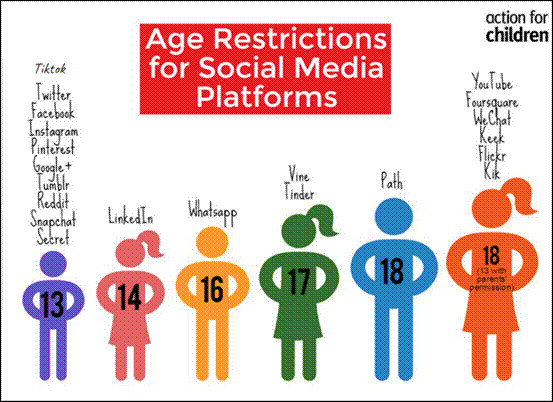
In order to support families to protect our learners online we are providing links below to support you in discussions with your child. Please also see the graphic below which shows the age restrictions for social media platforms.
Please click on the following links for guidance:
Tiktok
Instagram
Whatsapp
Influencers
Gaming
Snapchat
Resources available:
'What I wish my parents or carers knew...': A guide for parents and carers on managing children’s digital lives
Keeping children safe online | NSPCC
Keeping children safe online | Barnardo's
Support for parents and carers to keep children safe online - GOV.UK
Below is the latest Stay Safe Bulletin which has been shared with learners in form time. I have also delivered an assembly recently on Safer Internet day looking at the benefits and dangers of AI.
Please do not hesitate to contact the school if you need further help or support.
Regards,
Mr J. Keegan
Assistant Headteacher
Director of Safeguarding and Wellbeing
CONSIDER YOUR ONLINE REPUTATION
Anything you upload, photo, video, email or message could stay online forever. You should only post things online that you would not mind your parents/carers, your teachers or a future employer seeing.
SOME SIMPLE RULES TO MAKE YOUR ONLINE EXPERIENCE MORE PLEASANT AND SAFE
• Block abusive comments or people that abuse you.
• Respect others online and think carefully about the comments you post—comments can easily be misinterpreted.
• Don’t arrange to meet people in real life that you have only talked to online—some people might not be who they say they are.
• Check attachments and pop-ups for viruses before you click or download.
• Use secure and legal sites to download music and games to avoid the risks associated with streaming content from unauthorised sites.
• Be careful with the information you find on the internet. Not everything you read or watch will be 100% accurate, so watch out for being misled.
• Bullying someone online or sending inappropriate pictures could result in someone reporting you to the school or police.
• People don’t always show what their lives are really like on social media. Photos can be staged, airbrushed or filtered. People only show others what they want others to see. Do not compare yourself with these images.
STAY SAFE ON THE MOVE
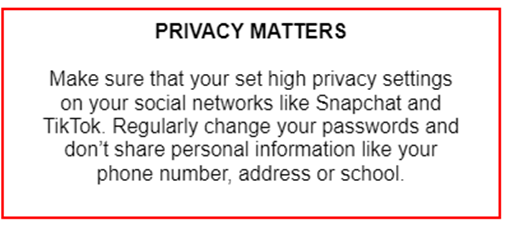
Make sure that you activate the safety and privacy setting on your mobile phone otherwise you may share too much information.
NUDES
A nude image can be nude or semi-nude sexual posing. It is illegal to send a nude image or video of yourself or someone else if you are under the age of 18. If you have sent a nude or semi-nude image, you can contact Childine and they will help you to have it removed from the internet.
GETTING SUPPORT
If you see or experience something you don’t like online you could speak to your parents or someone at school. We will listen and support you. We won’t judge you. You can report something bad you see online via the Internet Matters website
WE WILL ALWAYS LISTEN TO YOU AND SUPPORT YOU